How to Choose Among Private Schools in Atlanta: A Parent’s Guide
Table of Contents:
Searching for private schools in Atlanta can feel like a daunting job. The metro area is home to dozens of independent schools, each with its own culture, mission, and approach to education. Whether you just moved to Atlanta or you're exploring independent schools for the first time, it’s easy to feel overwhelmed with the options.
You want to make the right call for your child. But without a clear roadmap, you can get lost in open house calendars, admissions requirements, and school comparison rabbit holes.
That's where we come in. The Atlanta Area Association of Independent Schools (AAAIS) has been supporting families through this process since 1971. Our member schools serve over 40,000 students across the greater Atlanta area, and we exist to make it simpler and less stressful for your family to find the right school.
This guide walks you through what to look for, what questions to ask, and how the process works, so you can move forward with confidence.
TL;DR—How to Choose Among Private Schools in Atlanta: A Parent's Guide
Finding the right private school in Atlanta doesn’t have to be overwhelming. Here’s what to know:
- Independent schools set their own curriculum, teaching methods, and educational philosophy. This gives each school a distinct mission and culture.
- All AAAIS member schools are accredited, nondiscriminatory, and committed to partnering with families.
- The four factors that matter most when comparing schools are academic philosophy, class size, student support services, and campus culture.
- School visits reveal what websites cannot. Pay attention to how students and teachers interact, and bring your child when you can.
- The admissions timeline runs from October through April. All AAAIS schools share a common notification date, so you can apply to several schools without pressure.
- Financial aid at AAAIS schools is needs-based only. There are no academic, athletic, or artistic scholarships.
- Fit matters more than reputation. The best school is the one where your child will be known, challenged, and supported.
What Makes an Independent School Different
Independent schools are not all the same, and understanding the differences is a good place to start.
Unlike public schools, independent schools have far more freedom to shape their own curriculum, teaching methods, and educational philosophy. They are led by a Head of School and governed by a Board of Trustees whose focus is entirely on what is best for the students they serve.

What does that mean for your child? It means the school you choose is built around a specific mission and community rather than a one-size-fits-all approach.
All AAAIS member schools share a few important traits. They are:
- Accredited by a regional or national agency and recognized by all colleges in the U.S.
- Committed to nondiscrimination in admissions and school life
- Devoted to service and community outreach
- Engaged with families as true partners in their child's education
These are not just words on a website. They are requirements for membership in our association.
The Four Factors That Matter Most
Once you understand what independent schools are, the next step is knowing what to look for. Not every school is the right fit for every child. Here are four factors worth examining closely.
- Academic philosophy and approach
Independent schools offer rigorous academic programs with a focus on critical thinking and creativity. So the question you should be asking isn’t just "Is this school academically strong?" but also "Does the way this school teaches match the way my child learns?"
While some schools lean toward traditional, structured instruction, others take a more project-based or experiential approach. Spend time on each school's website and, during your visit, ask how teachers approach learning in the classroom.
- Class size and individual attention
Smaller class sizes are one of the most consistent advantages of independent schools. With fewer students per teacher, your child is more likely to get the personalized attention and support they need to thrive. It’s a good idea to ask each school about its average class size and how teachers address different learning styles within the same classroom.
- Student support services
Some students need more than a standard classroom offers. Several AAAIS schools specialize in working with students with special learning needs, and some offer a "school within a school" model to provide an extra layer of support. If your child has a learning difference, you can filter for this specifically using the school search tool at aaais.org.
- Campus culture and community
Academics are only part of the picture. There’s also the school’s culture and how strong the school community is. Pay attention to how students and teachers interact. Is the environment warm and engaging? Do students seem to know each other well? Co-curricular activities such as sports, arts, clubs, and community service shape the day-to-day experience just as much as the classroom does. Make sure the school's values feel like a natural extension of your own family’s values.

Three Things to Look for on Your School Visit
Visiting a school in person changes everything. You can read all the right things on a website and brochure, but walk onto a campus and you’ll know within minutes whether it feels right.
Most AAAIS schools host open houses in the fall and early winter, offer small group and individual tours, and provide shadow days for older students, where your child can spend part or all of a school day alongside a current student. These are some of the best ways to see the school in action.
Here is what to pay close attention to during your visit:
- How do students and teachers interact in the hallways? Are students greeted by name? Is the tone warm and respectful?
- What happens when a student struggles? Ask directly how the school supports students who are struggling academically or socially.
- Does your child feel comfortable? If you are able to bring them, pay attention to their reaction. Their gut feeling matters.
Come prepared with questions. Ask about academics, school culture, values, teacher qualifications, logistics, and more.
How the Admissions Process Works
The admissions process for Atlanta independent schools follows a clear timeline. Here is how it typically unfolds.
October: Most applications open around October 1. This is the time to start researching, narrowing your list, and registering for open houses and tours.
October through early February: Campus visits, required testing, and open house events take place during this window. Depending on the grade level, your child may need to complete the SSAT (for grades 6-12) or the JATP (for Kindergarten through grade 5). Check with each school to confirm what is required.
January and February: Many AAAIS schools schedule on-campus interviews during this period, some during the school week and some on Saturdays.
Late January or early February: Application deadlines. Full application packages often include teacher recommendations, transcripts for older students, and parent and student questionnaires. Give yourself plenty of time to gather everything.
The last Saturday in March or the first Saturday in April: This is the common notification date, and is one of the most family-friendly features of applying to AAAIS schools. All member schools release their acceptance decisions on the same day, so you are not left waiting on one school while another pressures you to decide.
About two weeks after notification: The common response date. This is when you let your chosen school know you are accepting their offer.
How to Compare Schools and Make Your Final Decision
After visiting a few schools, you will likely have a sense of which ones felt right and which ones did not. Trust that instinct, and pair it with some practical thinking.
A few tips for comparing your options:
- Write down your priorities before you start visiting. What matters most to your family: location, class size, religious affiliation, a specific academic program, support for learning differences? Having a short list before you tour helps you evaluate each school against the same standard.
- Talk to current parents. The school staff will always present the school in its best light. Current parents will give you a more honest picture of day-to-day life. It’s also an opportunity to network with other parents.
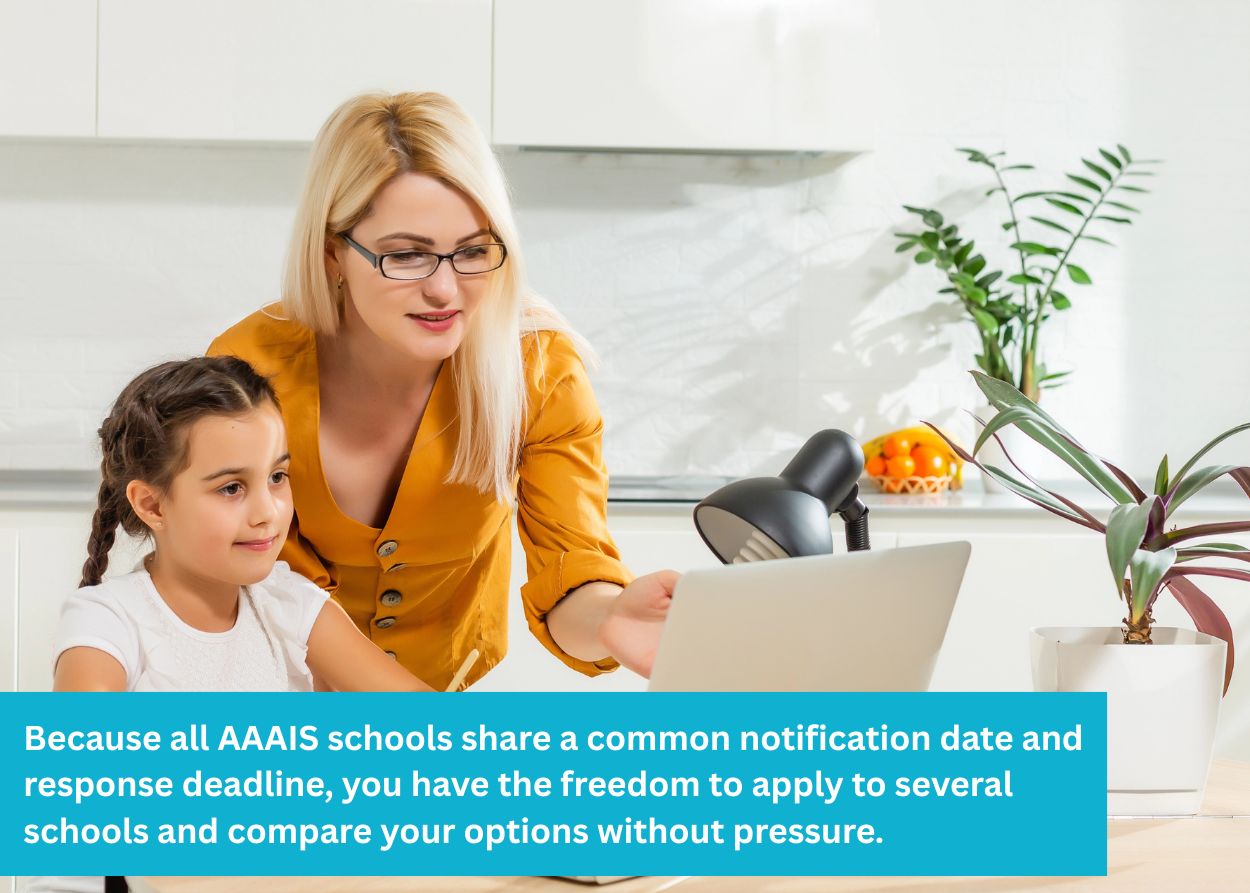
- Apply to more than one school. Because all AAAIS schools share a common notification date and response deadline, you have the freedom to apply to several schools and compare your options without pressure.
- Remember that fit matters more than reputation. The best school is the one where your child will be known, challenged, and supported, not necessarily the one with the most well-known name.
If you find none of the schools you applied to feel like the right match, don’t be discouraged. AAAIS schools operate on the principle of cooperation, not competition. If a school is not the right fit for your child, they will help point you in a better direction.
Your Next Step Starts Here
Imagine your child walking into school each morning knowing their teacher by name, feeling confident in the classroom, and coming home genuinely excited about what they learned that day.
That is what we work toward, and what we want every child to experience in our schools.
As a parent, here is how you move forward:
- Start with our school search tool at aaais.org/school-search to browse and filter all AAAIS member schools by location, grade level, focus, and more.
- Attend open houses or schedule a tour at two or three schools that seem promising. Use the AAAIS admissions event calendar to find upcoming events.
- Use the questions and factors in this guide to compare your options and stay focused on what matters most to your family.
- Reach out to us at aaais.org/contact if you have questions along the way.
Finding the right school takes time. But with the right resources and a clear sense of what you are looking for, you will get there.