How to Compare Independent Schools in Atlanta Without the Pressure
You have four browser tabs open, four tuition pages, and four sets of photos showing happy kids in sunny classrooms. They all look good, but an hour in, you're no closer to knowing which one fits your child. Underneath it all, you feel a nagging worry that spots are filling up, and if you don't decide quickly, you won't get the school you want.
When you sit down to compare independent schools in Atlanta, the hard part isn't the research. It’s the feeling of being rushed into a decision that shapes your child's future.
You’re not the only one to feel that way. To help, school leaders and admissions directors founded the Atlanta Area Association of Independent Schools in 1971 to end high-pressure admissions procedures and put families first.
Keep reading to learn what to compare at each school, which common traps to avoid, and how the Atlanta admissions calendar takes the pressure off.
TL;DR—How to Compare Independent Schools in Atlanta Without the Pressure
No time to read? Here's the short version.
- No AAAIS member school will push you to commit early.
- All AAAIS schools send their decisions on the same day in late March or early April, so applying to four schools doesn't put you behind a family that applied to one.
- Compare the same six things at every school instead of comparing overall reputation.
- A ranking score or a tuition price can't tell you whether a school will be a good fit for your child.
- Narrow your list to three or four schools before you start visiting campuses.
The 1 Rule That Takes the Rush Out of Admissions
The single most useful thing to understand about AAAIS member schools is that they agreed a long time ago not to compete for your yes.
All AAAIS general purpose schools release admission decisions on the same common notification date, in late March or early April. They also share a common response date two weeks later. Between those two dates, our member schools agree not to initiate contact with accepted families, so you have the space to make your own decisions.
This fact changes everything about how you compare schools:
- Applying to four schools does not put you behind the family that applied to one.
- No school can call you in February and pressure you for an early commitment.
- When the decisions arrive, they arrive together, and the choice belongs to your family.
There are a few sensible exceptions. Schools that specialize in serving students with special learning needs may admit on a rolling basis. And, critically, if a non-AAAIS school gives you an early deadline, you can contact the AAAIS schools you applied to and explain the situation. Our schools are allowed to make an exception in that case. You can find the full timeline on our Admissions Info page.
6 Things to Compare Side by Side at Every School
Once the clock pressure is gone, comparison becomes a simple exercise: ask every school the same six questions, and keep track of the answers.
- Academic approach. It’s worth learning about the different types of academic approaches. Montessori classrooms are hands-on and let children work at their own pace. International Baccalaureate programs follow a structured international curriculum built around inquiry and writing. Traditional college prep uses set course sequences and regular testing, often including Advanced Placement courses. Those are three of many, so ask which approach a school uses, then ask what a normal day looks like in your child's grade.
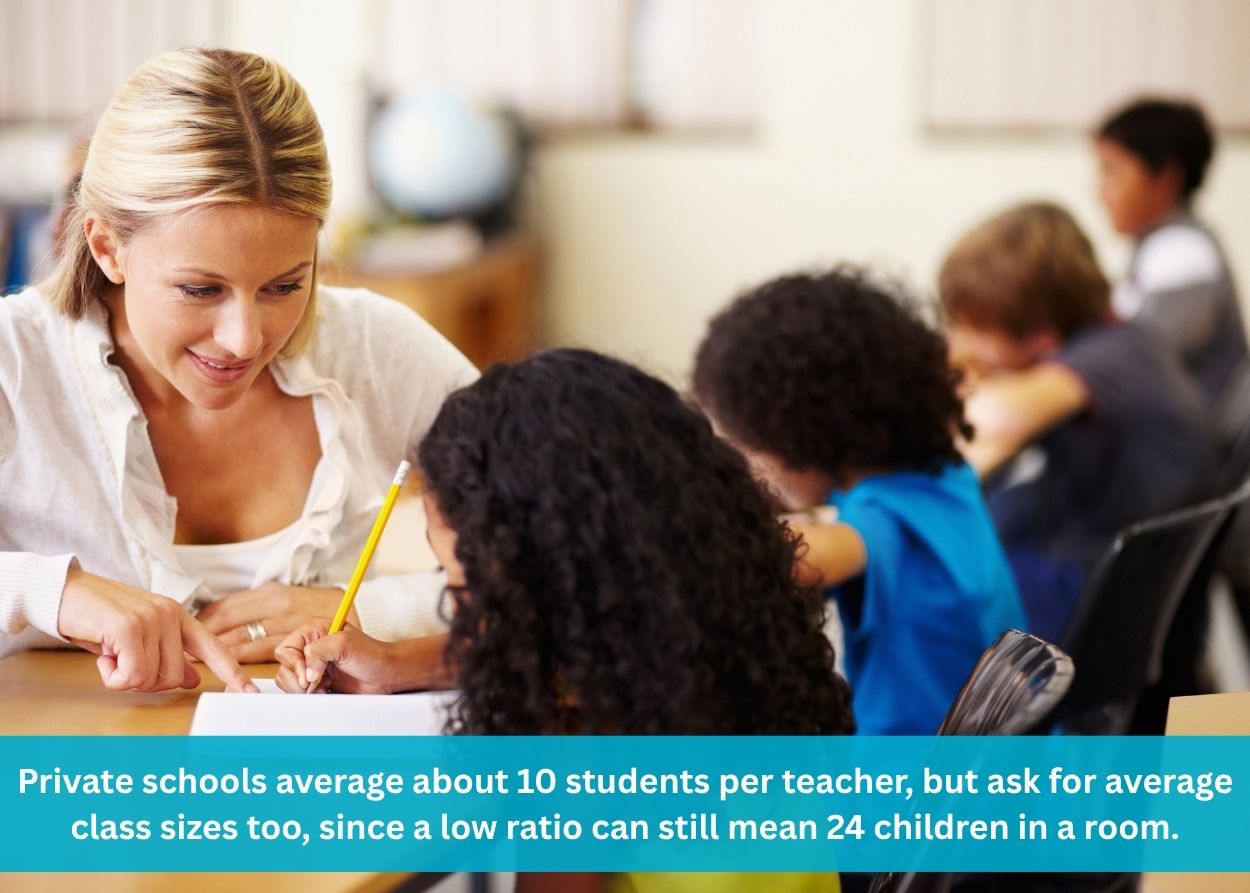
- Class size and teacher attention. Private schools nationwide average about 10 students per teacher, so you have a number to measure answers against. Ask for average class sizes too, since a school can report a low ratio and still seat 24 children in a room. Then ask how teachers handle different learning speeds in one class.
- Learning support. Some of our member schools specialize in students with learning differences, and some offer a "school within a school" model. The nonprofit Understood has good background on what real support in a school looks like.
- Culture and belonging. Watch how students greet each other in the hallway. This matters more than it sounds. Children who feel they belong at school stay more engaged in their schoolwork and perform better academically.
- Grade span. Does the school end at grade 8? If so, you will run this process again in a few years. Some families want that flexibility. Others do not.
- Total cost. Ask about fees, technology, trips, and needs-based financial aid, and not just the tuition cost.
If you want a deeper look at these factors, our guide on how to choose among private schools in Atlanta covers this topic in more detail.
4 Comparison Traps That Add Pressure
All four of these wrong thinking patterns should be avoided if you want to settle on the best-fitting school for your child.
- Chasing rankings. Ranking sites flatten schools into a single score. But independent schools are, by definition, different from one another. As the National Association of Independent Schools explains, each school sets its own mission, curriculum, and philosophy. A ranking cannot tell you which mission fits your child.
- Using tuition as shorthand for quality. Price reflects campus size, endowment, and program mix. It does not reflect how well a school will care about your eighth grader.
- Following another family's choice. Their kid is not your kid. The school that was perfect for the neighbor's outgoing athlete may be wrong for your quiet reader.
- Hunting for the best school. There is no best school, but there’s a best fit, and it’s different for every child. Our member schools believe this so strongly that when a school isn't right for your family, they will point you to one that is.

How to Go From 68 Schools to a Short List of 4
The fastest way to shrink a big list is to filter before you research, and research before you visit.
Filter first. Use our school search tool to sort member schools by location, grade level, religious affiliation, special focus, and learning support.
Research second. Read mission statements. Look at the daily schedule. Check whether the school requires the SSAT, the JATP for younger applicants, or another assessment.
Visit last. Save campus visits for three or four finalists. Visits take real time and energy, and they are much more useful once you know what you are looking for.
Our schools vary widely. Sizes range from under 50 students to more than 2,200, and some begin with toddlers while others begin with high school. Our post on what makes Atlanta's independent schools different is a good place to begin if you want that background before you filter.
Your Family's Next Step
It’s a Saturday morning in early spring. Your results have all come in on the same day, and you read them at your own kitchen table. Nobody is calling, and nobody is pushing you for a decision. You have time to think, and the choice is yours.
Let's recap the four steps that get you there:
- Filter member schools with our school search tool.
- Compare the same six things at every school on your list.
- Visit your three or four finalists, contacting each school directly since every school handles its own admissions.
- Apply to every school that fits, and check the key dates on our Admissions Info page.
We are not a school system, and we will not tell you where your child belongs. We just make sure you have the time and the information to figure that out yourself. But don’t hesitate to reach out any time you have a question along the way.